Women of the Empire
I’ve been meaning to write a long review of all the books that encompass Asimov’s Foundation Universe, but after a few drafts I’ve realized that they were full of criticism and forced me to think Have I really enjoyed these books? Yes! Yes, I enjoyed them a lot. Why then the complaints?
Lately, I’m trying to be more positive with my thoughts. I’ve found it’s very easy to let myself fall into criticism and focus on the bad aspects of everything, so I’m trying to make a conscious effort to focus on the positive. What I’m doing is the following: I allow myself one criticism, and then I force myself to think of at least three good aspects. I think I read about this strategy a while back somewhere, but I can’t recall. And it’s helping. When I finish going through this exercise I feel more at ease, and it leaves me with a good taste. I no longer remember things by the aspects I didn’t like, but by what I liked about them.
So, I’ve been reading all the Foundation books in the “discovery order”. Consecutively it has taken me around seven months. In case anyone is interested, this is the order:
- I, Robot
- The Robot series
- The Caves of Steel
- The Naked Sun
- The Robots of Dawn
- Robots and Empire
- The Empire series
- The Stars, Like Dust
- The Currents of Space
- Pebble in the Sky
- The original Foundation trilogy
- Foundation
- Foundation and Empire
- Second Foundation
- Foundation sequels
- Foundation’s Edge
- Foundation and Earth
- Foundation prequels
- Prelude to Foundation
- Forward the Foundation
If I had done more research, I would have probably read The Complete Robot first, instead of I, Robot, because it contains the most stories. But it would have been a mistake. I, Robot has small bits that The Complete Robot doesn't. In I, Robot, the different stories are wrapped by the frame of a reporter's interview with Susan Calvin, with small interludes in the interview. This adds a bit of flair to the book.\ On the other hand, The Complete Robot has a lot more stories but feels more disconnected. Here's a useful guide to the stories contained in each collection.
Having said this,
The bad thing
Asimov’s characters are pretty sexist. Centuries have passed from the first books to the last ones but apparently, in Asimov’s view, women keep being relegated to a second position or completely dismissed for eternity. The Empire series is the worst in this aspect, so if you’re easily triggered you can skip them (you won’t be missing a lot, being disconnected from one another, and not very relevant in-universe either).
The good things
The enormity of the Galaxy.\ There are a lot of science fiction novels (and movies) that have tried to show how vast space is, but few have managed to convince me. Throughout the twenty thousand years (give or take) contained in the Foundation Universe, we see humanity starting to explore the Solar System, then developing the hyperdrive, the colonization of planets, and later on the formation of empires, factions, and galaxy-wide wars. Sometimes not going into much detail, we can see glimpses of entire civilizations being engulfed by a stronger opponent. We see knowledge being lost as planets are abandoned or devastated.\ And people travel, and it takes time. It’s not like Star Wars, where they click a button and they appear to cross the galaxy in an instant. Here, especially in the sequels, we see the relevance of travel through massive amounts of space and between star systems. The ships have to get away from the gravitational pull of planets to be able to “jump” through hyperspace, and this can take weeks.
The technological progress.\ Perhaps an obvious thing to focus on, but I really liked how some of the technology has advanced so much, that some old information can no longer be accessed. A lot of ancient languages have died, only to be preserved in legends and ancient fragments. We see Pelorat (a History professor) trying to sift through lots of old myths to find clues as to the location of Earth, by this point a mythical world that a minority believe is the origin planet of humanity. We see libraries that no one will ever access, as they are in a format not compatible with modern computers and no one has time to port them to the new systems.\ We also see some technology that has persevered through the ages, like the neuronic whip or blasters. The novels don’t mention it, but I hope they underwent some upgrades. Also the ships. The Foundation, being “physical scientists”, continues evolving technologically, surrounded by a crumbling Empire that has lost knowledge of atomics. By the time of Foundation’s Edge, we see the Second Foundation using completely outdated ships, while the Foundation uses the latest model of gravitic ships, featuring a mental interface built into the ship.\ It was amazing having to stop mid-sentence and go back a bit to reread a fragment, thinking wait a second, is that a tablet? What year was this written on?
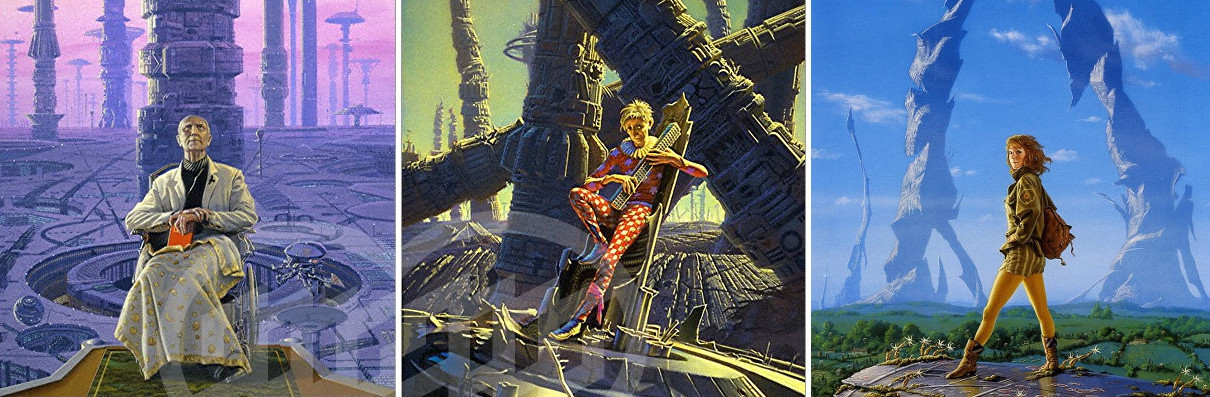
The women of the Empire.\ Despite The bad thing, there are some great women moving the threads of history. In I, Robot we have Susan Calvin, the chief robopsychologist of US Robots and Mechanical Men. She has dedicated her life to robots and understanding them. She cares deeply about her robots, and she doesn’t take shit from anyone. If it weren’t for Susan Calvin, robots wouldn’t have evolved nearly enough to trigger the emigration to the outer planets of the people who would become the spacers.\ In Foundation and Empire, we meet Bayta Darell, who can trace her ancestry back to Hober Mallow. Together with her husband Toran, Ebling Mis and the Clown, travel to Trantor, where Ebling Mis focuses his energies on finding the Second Foundation in the hopes that they can save them from the Mule. It’s Bayta who first realizes that the Clown is actually the Mule, and she kills Ebling to prevent him from telling the Mule the location of the Second Foundation (the Mule can make people do whatever he wants, controlling their will). Bayta shows a great power of mind to avoid detection. She becomes a heroine of the Foundation for her actions.\ Harla Branno appears in Foundation’s Edge. She’s the Mayor of Terminus and the leader of one of the three factions in this novel. The Foundation is at the height of its power, controlling a lot of planetary systems through their technological might, and Mayor Branno is the leader of it all. Despite the common belief that the Second Foundation no longer exists, she believes it still does and prepares accordingly. She equips her ships with shields to block the influence of mentalics and strategizes for possible outcomes of her attempts to locate them. She wields power in the council and knows how to influence people to do her bidding. Ultimately it doesn’t end up so well, but it was refreshing to see a woman in a position of power.\ Last but not least, Gladia appears in The Naked Sun and in the following novels of the Robot series. Gladia starts as the widow of a recently murdered “fetologist”. She’s clearly repressed by the Solarian society, who have taken individuality to the extreme of experiencing distress in the presence of another human being. In the following Robot novels, she moves to Aurora and experiments with the sexual openness of that society, until she settles keeping mostly to herself, in the company of her robots. Gladia influences heavily the events that lead to the second wave of colonization by Earthmen (the settlers). Later on, accompanied by the robots Giskard and Daneel, she travels to settler worlds, overcoming the spacer panic of germs, and mingling with everyone. Gladia is a character who evolves and adapts to a lot of different environments, never fully at home anywhere. It was a joy seeing her happy at the end with D.G. Baley, having found her purpose.
There’s so much variety in the Foundation Universe that it’s complicated to give it a rating. It’s fifteen novels, after all. I really enjoyed picking up I, Robot, and keep on reading until the last book in the Universe. The books made me dream of amazing and distant worlds full of stories and lives to be explored.